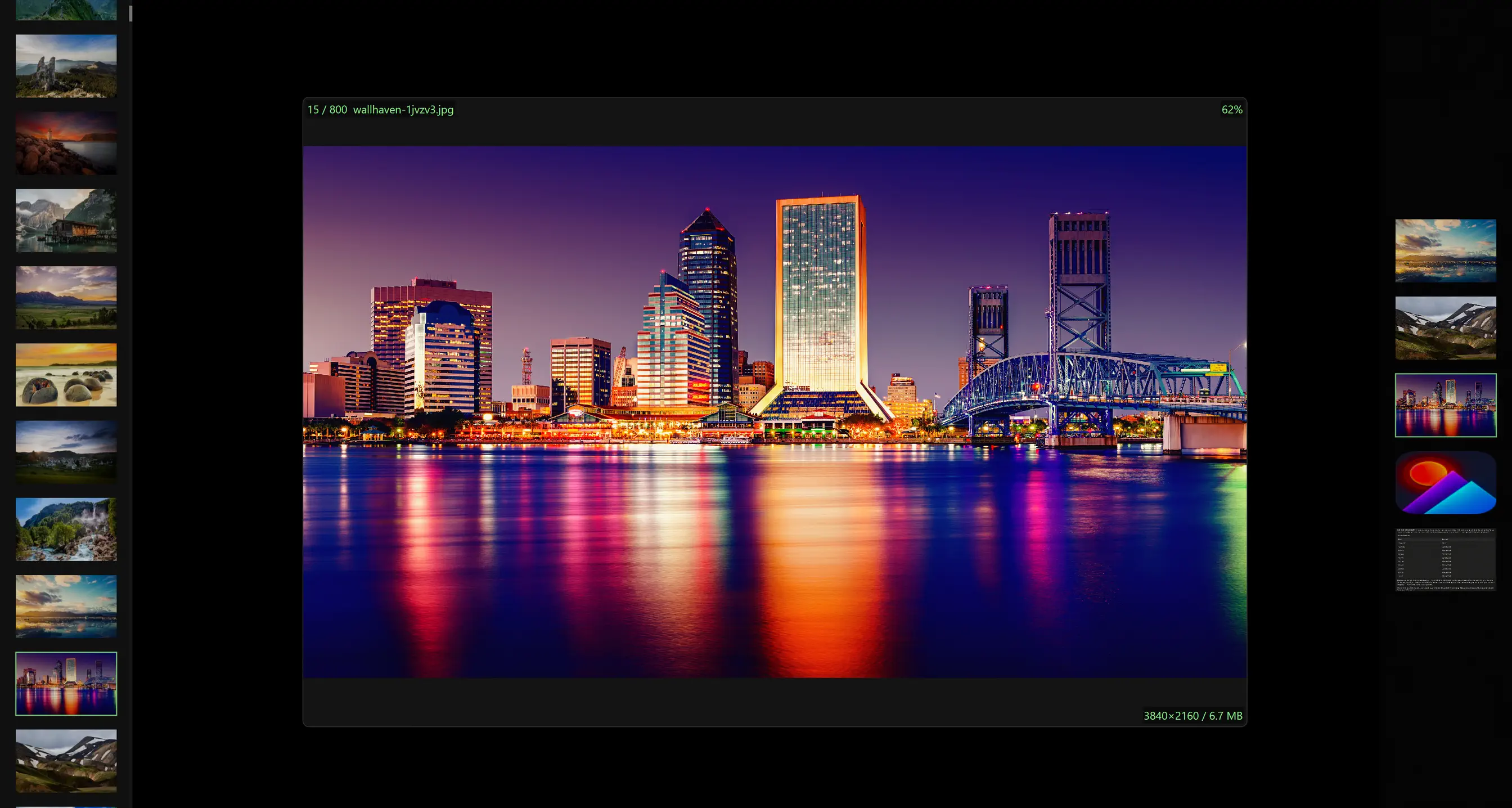
Why QuickImageViewer?
Built for Speed
Unlike modern web-based Electron wrappers, qIV is a pure native application. It uses a GPU bitmap cache to keep decoded images in VRAM, preloading in both directions on a background thread pool. The UI thread never blocks — switching between images is instant.
Hardware Accelerated
Built directly on top of Direct2D, D3D11 and the Windows Imaging Component (WIC). Zero-flicker rendering with per-panel DXGI swap chains, full per-monitor DPI awareness for crisp 4K rendering, and a GDI software fallback when needed.
Genuinely Portable
One sub-10 MB EXE. No installer, no background services, no telemetry, no ads.
Hide it to the system tray with Esc and the process stays resident in
RAM — the next image opens instantly.
More Than a Viewer
Cull a shoot in one pass — one keystroke per picture, keep or reject, rejects moved together at the end. Thumbnail strips double as a lightweight file manager: drag & drop files between folders, right-click Copy / Cut / Paste / Delete with full Windows clipboard and Recycle Bin integration, plus offline EXIF GPS geocoding.
Format Support
Open HEIC, AVIF, JPEG XL, WebP, SVG, OpenEXR and Radiance HDR on Windows — plus every classic format. Native OS formats are handled by the zero-dependency Windows Imaging Component, while complex formats use optimized custom and static-library decoders.
| Format | Extensions | Decoder | Notes |
|---|---|---|---|
| JPEG | .jpg .jpeg .jpe |
WIC | Full EXIF / GPS metadata |
| PNG | .png .apng |
WIC | 16-bit, alpha |
| BMP | .bmp |
WIC | |
| TIFF | .tif .tiff |
WIC | Multi-page (first frame) |
| GIF | .gif |
WIC | Animated — plays with per-frame delays |
| WebP | .webp |
WIC | Windows 10+ native codec |
| HEIF / HEIC |
.heif .heic .hif .heics
.heifs
|
WIC | Requires MS HEIF Extensions |
| AVIF |
.avif .avci .avcs .avifs
|
WIC | Windows 11 native codec |
| JPEG XL | .jxl |
WIC | Windows 11 24H2+ native codec |
| JPEG XR | .jxr .wdp .hdp |
WIC | OS native |
| DDS | .dds |
WIC | OS native |
| Camera RAW |
.dng .cr2 .cr3 .nef .arw
|
WIC | Requires MS Raw Image Extension |
| JPEG 2000 |
.jp2 .j2k .j2c .jpf .jpx
|
OpenJPEG | Static lib |
| SVG | .svg |
resvg | Rust static lib, async IO thread |
| OpenEXR | .exr |
tinyexr | Reinhard tone-map + γ2.2 |
| Radiance HDR | .hdr |
Inline | RGBE adaptive RLE, Reinhard tone-map |
| Targa | .tga |
Inline | RLE and colour-mapped, 8/15/16/24/32-bit |
| PNM | .ppm .pgm .pbm |
Inline | P1–P6, up to 16-bit maxval |
| QOI | .qoi |
Inline | Lossless fast format |
| ICO / CUR | .ico .cur |
WIC |
Core Features
Performance
- GPU bitmap cache — decoded images live in VRAM, preloaded in both directions
- Background decode — worker thread pool; the UI thread never blocks on IO
-
Instant startup — process stays resident in RAM after first launch
(hide to tray with
Esc, recall instantly) - Software fallback — GDI renderer for edge cases where Direct2D is unavailable
- Per-monitor DPI awareness V2 — pixel-perfect rendering on 4K and mixed-DPI setups
Finding pictures
- Search every folder qIV knows — Ctrl+F searches the folder on screen, Ctrl+Shift+F searches the whole history. Find a picture by name without remembering where you put it, and open it straight from the result. Pressed while Find is already open it widens the search you are typing rather than closing the panel.
-
Narrow it by size or date — type
>5mb,<500kb,>2024or<2024-06into the same box, next to a name or on their own.>5mb sunsetfinds the big ones called sunset;>5mbby itself lists everything over five megabytes. A word only becomes a filter when it cannot be anything else, so ordinary filename search is untouched — a file actually named2024still matches. - Duplicate finder (Ctrl+D) — identical copies across every folder qIV knows. Files are grouped by size first, so almost nothing is read; only files that share a size are opened and compared byte for byte. No hash, no “probably”: a re-encoded or rotated version is a different file and is deliberately not listed.
-
See them before you decide — results are numbered by group
(
1. 1. 1. 2. 2.), and clicking a row shows every copy in that group side by side with the selected one framed. Identical files usually differ only in name, so looking at them together is the only way to be sure. Right-click a row or a thumbnail to open it, show it in Explorer, or send it to the Recycle Bin — never a straight delete. - Your folders on the taskbar — right-click qIV's taskbar button and Windows lists your favourites and recent folders, each opening that folder directly. Built from the same history the Tab panel shows, so the two cannot disagree.
Culling a shoot
- One keystroke per picture — Alt+Space starts a cull, then K keeps, X rejects and U clears the mark. Each one advances by itself, so four hundred frames is four hundred keys and no mouse. The filename carries its mark as you go — a tick, a cross, or a dot for one you have not judged yet.
-
Nothing is written until you say so — the marks live in memory.
Leaving the mode is what asks, and the count it names is the count it moves. Files go
to a
_rejectedfolder beside them — same drive, same place, undoable with Ctrl+Z in Explorer. Say no and nothing moves. - Or keep the winners instead — whichever mark you used is the one that acts. Mark rejects and those move; mark only keeps and you are asked whether to move everything else. That is how four hundred frames become the twelve good ones without rejecting the other 388 one at a time.
- Or forty at once, from a strip — while the mode is on, every thumbnail strip tints by mark, green for keep and red for reject, and its right-click menu gains Mark Keep, Mark Reject and Clear Mark. Those act on the whole selection.
Guides
- Turn an old phone or tablet into a digital photo frame
- Find duplicate photos without deleting the wrong one
- Open EXR and HDR files on Windows, without a plugin
File Management
-
Drag & Drop between folders: Drag a thumbnail from one directory
strip onto another to move the file; hold
Ctrlto copy. The cursor shows the active operation and both panels refresh instantly. - Clipboard integration: Right-click any thumbnail for Copy / Cut / Paste / Delete. Works both ways with Windows Explorer; cut files are shown dimmed; deletes go to the Recycle Bin.
Theming — a dial, not a switch
Most viewers give you dark or light. qIV gives you every point between them,
live. Ctrl+Alt+Num + and Ctrl+Alt+Num - move a single
theme factor from 0.0 to 1.0 in steps of 0.05 — 21 stops
from full dark to full light. Every panel, scrollbar, overlay and window background
re-tints as you press, with no restart. Ctrl+Alt+Num 0 returns to the default.
It is one formula, applied to each colour channel independently:
Final = Base + factor × (1 − 2 × Base).
- At 0.0 the maths cancels out exactly — the dark theme is not an approximation of a neutral one. Every colour is bit-for-bit its designed value.
- At 1.0 each channel inverts, giving a true light theme.
- Hue survives the journey — red, green and blue invert independently rather than through a lightness curve, so the yellow shortcut column, the blue links and the red “directory missing” heading stay recognisably themselves at every stop instead of washing out to grey. Alpha is never themed, so nothing changes opacity as the dial moves.
- Windows follows along — crossing the 0.5 midpoint flips the app between dark and light mode, repainting the title bars of the main window and every floating panel so the frame never disagrees with the contents.
- It is remembered — stored as a whole percent and clamped at both the runtime setter and the registry load, so a hand-edited value cannot reach the renderer.
Two neighbouring controls change the window's material rather than its colour, both
Windows 11 22H2+ and silently ignored on older builds:
Ctrl+Shift+Num * toggles rounded ↔ square corners, and
Ctrl+Shift+Num / cycles the backdrop None → Mica → Acrylic →
MicaAlt.
Offline Reverse Geocoding
GPS coordinates in EXIF data are resolved to full location details with zero network calls. All data is compressed (zlib) and embedded directly in the EXE.
| Data | Source | Entries | Shows |
|---|---|---|---|
| Cities | GeoNames cities1000 | 170,387 | City name, timezone |
| Admin1 | admin1CodesASCII | 3,865 | State / Province |
| Admin2 | admin2Codes | 47,549 | District / County |
| Country | countryInfo | 252 | Country, Capital, Continent, Currency, Phone prefix |
Complete Shortcut Reference
Every shortcut in qIV — all 240 of them, in 17 sections — has its own page, generated from the application's own help panel so it can never fall behind the build:
Or press F1 in the app for the same list, on your own machine, with your own keyboard layout.
System Tray
When qIV is hidden or running in the background, its icon lives in the system tray. Right-click it for the full settings menu — no config files to edit. Double-click to restore the window.
Settings submenu — toggles
| Setting | Effect |
|---|---|
| Keep in Background | Esc / Ctrl+W hides to tray instead of exiting; process stays resident for instant re-open |
| Run on Startup | Write / remove a Windows startup registry entry so qIV launches with Windows. Dedicated instances use a separate entry |
| Thumbnail Effects | Master switch for glow borders, rounded corners and hover-scale on thumbnail strips |
| History: Open Full List | Tab opens the full uncapped history view when enabled |
| Info Overlays | Show / hide all nine overlay text slots |
| Open Thumbnail Strip on Start | Auto-open the directory strip on every launch |
| Folder Walk Wraps Around | Whether Alt+Left / Alt+Right roll from the last sibling folder back to the first. On by default; off stops at each end and says so |
| Overlay Background | Semi-transparent background panel behind overlay text |
| Swap Mouse Buttons | Exchange left/right roles: hold-to-zoom ↔ drag-to-move-window |
| Invert Scroll Direction | Reverse vertical wheel for image navigation |
| Invert Horizontal Scroll | Reverse horizontal wheel for folder history navigation |
| Start in Fullscreen | Open fullscreen on every launch |
Settings submenu — numeric values
Click any numeric label to open an input dialog. Current value is shown in the menu item itself.
| Setting | Range | Effect |
|---|---|---|
| VRAM Cache Size | 0 – 999 | Images to keep decoded in GPU memory |
| Window Width / Height | 240 – 16000 px | Default dimensions used by Ctrl+Space and window reset |
| Dir Thumb Cache | 0 – your card's VRAM | Memory budget for directory thumbnail bitmaps. 0 turns the cache off, keeping only the thumbnail on screen; the maximum is this card's own graphics memory, which the dialog shows when it can read it. The Statistics panel reports both the budget and the card's total |
| Preload Lookaside | 1 – 99 | Images to pre-decode ahead and behind the current one |
| Overlay Message Duration | 250 – 10000 ms | How long center overlay messages stay visible |
Settings file operations
Export and Import moved to the top-level Backup & Export menu, with the log and TCP/IP archives.
| Item | Effect |
|---|---|
| Restore Defaults | Reset every setting to its compiled-in default — confirmation required; history and favorites are not affected |
Settings › History
Everything about the folder history in one place — what gets recorded, how much of it is shown, and how to tidy it up.
| Setting | Default | Effect |
|---|---|---|
| Record Folders I Visit | On | Master switch. Off stops new folders reaching the list and qivHistory.txt. Nothing already saved is removed, and navigation is unaffected |
| Record Only Folders With Images | On | Folders holding no images are not recorded — what stops the Alt+arrow folder walk filling the history with folders you merely stepped through. A folder dropped on the window is recorded either way |
| Tab Opens Full List | Off | Tab opens the uncapped list. Ctrl+Tab opens it once whatever this is set to, so the setting picks the default rather than the only way in |
| Rows Shown in Panel | 0 – 999 | How many history rows the panel draws. Display only |
| Favorite Rows Shown in Panel | 0 – 999 | How many favorite rows the panel draws. Display only |
| Favorites You Can Add | 0 – 999 | How many folders may be starred at once. Also caps qivFavorites.txt on load, merge and save — lowering it drops favorites past the new limit |
| Folders Saved to File | 1 – 99999 | How many folders qivHistory.txt keeps; oldest dropped past this |
| Remove Invalid Folders | action | Drops rows that cannot be parsed as a path, point at a missing folder, or hold no images. Rows the background scan has not reached yet are kept and reported, so an early run says it was partial |
| Remove Duplicates | action | Collapses repeats, keeping the most recent. Usually removes nothing from the list — the real work is rewriting the append-only file |
| Clear History | action | Removes every non-favorite folder from the list and the file |
| Clear Favorites | action |
Un-stars everything and empties
qivFavorites.txt. The folders stay in the history,
only the star goes
|
| Clear History and Favorites | action | Empties both lists and both files in one action |
| Open History File | action | Selects qivHistory.txt in Explorer |
Every action asks first and backs up the file it is about to change, so any of them can be undone with Backup & Export › Restore History & Favorites. Remove Invalid Folders and Remove Duplicates never touch favorites; the three Clear items are the only ones that do, and each names what survives it.
Backup & Export
Every operation that moves qIV's data on and off the disk, in one top-level menu.
| Item | Effect |
|---|---|
| Export Settings | Save all settings to a UTF-8 .ini file (filename includes today's date) |
| Import Settings | Load a previously exported .ini — confirmation required; all settings applied immediately |
| Backup Logs | Zip the whole logs folder, general and network together, to a location you choose. One-way — a log is a record, there is nothing to restore it into |
| Backup TCP/IP Config | Zip qivLocalServer.ini, qivRemoteServers.ini and qivRemoteServerBlacklist.ini. None of these are in the registry, so Export Settings never covered them |
| Restore TCP/IP Config | Restore those three files. Asks per file before replacing one that already exists, and needs a restart — a running listener keeps the settings it started with |
| Backup History & Favorites | Export history and favorites to a .zip archive |
| Restore History & Favorites | Restore from a previously created backup — confirmation required |
The TCP/IP archive holds your allow-list and the stored password hash (PBKDF2, not plaintext) — keep it as private as the configuration itself. The logs archive is the one meant to be handed to somebody else.
Other submenus
| Submenu | What you can change |
|---|---|
| View Mode | Default fit mode: Fit to view · Fit to width · Fit to height · Stretch · Original size |
| Slideshow | Interval (100 – 60000 ms), Loop, Shuffle, transition type (Cut / Fade / Dissolve / Ripple / Push / Zoom) |
| Sort | Sort order (Name / Date / Size / Type / Disk) and Reverse Order toggle — takes effect immediately |
| Backup |
Backup history & favorites to a .zip archive, or restore from
a previous backup
|
| Logging |
General Log — what qIV itself did: started, closed, and
whether the previous run ended abnormally (with the crash dump's filename when
there is one). TCP/IP Log — every line exchanged with a
remote client, the same traffic the Server Log panel shows (Ctrl+F12),
written to disk as well. Open Log Folder opens logs\
in Explorer
|
Both logs are off by default and survive a restart once switched on — which is the point of them. A screen that misbehaves at four in the morning is exactly the one nobody was watching, so the setting is persisted rather than something you must remember to enable first.
Files land in logs\general\ and logs\network\ beside the EXE,
named QuickImageViewer_General_<timestamp>.log and QuickImageViewer_Tcp_IP_<timestamp>.log,
rotating every 5000 lines. Switching a log off and on again continues the newest file
rather than starting a fresh one.
The format is the standard time [thread] LEVEL message layout, so
LogViewPlus,
lnav and similar tools parse it with no configuration — and a rotated TCP/IP file
opens straight back in the Server Log panel with Ctrl+O. Writing happens on a
thread of its own: a slow disk cannot stall the viewer, and with a log switched off the
cost at each record point is a single atomic read.
Dedicated Screens
Press F8 for the Dedicated panel. A dedicated screen is a separate copy of qIV with its own settings file beside it — normally parked fullscreen on one monitor running a slideshow. Any number can run at once, alongside the main app, sharing nothing.
How a copy is identified
Everything derives from the executable's own path, so two screens can never resolve to the same settings, mutex or window class — two files cannot share a name in one folder.
D:\Screens\qIV_dedicated_Lobby.exe                  the copy
D:\Screens\qIV_dedicated_Lobby.ini                  its settings
D:\Screens\imageLists_qIV_dedicated_Lobby.qim       image folders
D:\Screens\promotionList_qIV_dedicated_Lobby.qpr    promotion folders
Startup decision
Made from the filesystem before any setting is read:
| Condition | Result |
|---|---|
An .ini sits beside the exe |
Settings come from it; the registry is never touched |
Exe name contains dedicated, no .ini |
A default .ini is generated and the F8 panel opens |
| Neither | Normal registry-backed launch |
Inside the .ini, [Instance]Dedicated decides behaviour —
1/true/on/yes or any non-zero number.
Set it to 0 and you get a portable ordinary viewer: settings
in a file, history and favorites intact, nothing in the registry.
Panel buttons
| Button | Action |
|---|---|
| Generate App |
Copy this executable to a chosen folder as qIV_dedicated_<name>.exe
|
| Generate Config |
Write that copy's .ini, holding every setting shown in the panel
|
| Add Images / Add Promotions |
Append a folder to the .qim / .qpr list —
duplicates reported and skipped
|
| Add Startup / Remove Startup |
Create or delete a shell:startup shortcut pointing at the copy
|
| Test Config / Test Images / Test Promos | Check one thing at a time |
The panel edits the config only — it never changes the app you are using, and every value starts from the compiled defaults rather than your current settings, so a screen never inherits the authoring machine's preferences.
Test Images / Test Promos count the images actually found per
folder and flag folders that are missing or empty. A folder that exists but holds nothing
decodable looks identical to a working one until the screen goes blank.
Kiosk lock
Tick Kiosk lock in the panel and the screen ignores every key and every
click — nobody walking past can pause the slideshow or open a panel. The tray icon
keeps working (its menu runs its own message loop, so the locked window never sees those
messages), and Settings › Kiosk Lock there is the only way back
in. The main app has the same toggle in its tray menu, and -lock forces it on
for a single launch without changing the stored setting.
Always on top
Keeps the screen above every other window so nothing that pops up can cover it. Ctrl+T toggles it live and the setting persists; the panel sets it for a generated screen.
Keep display awake
Blocks the screensaver and display sleep while the window is on screen. Leave it off and Windows eventually blanks the display with nobody there to wake it — and with the kiosk lock on, nobody could. The hold is released automatically when the window hides to the tray, so a viewer sitting in the tray never keeps a machine up.
Isolation
A dedicated screen writes nothing to the registry, keeps no history or favorites,
and has its own mutex and window class — so a file opened from Explorer can never
land on a slideshow instead of the main window. It auto-starts from a shortcut rather than
the Run key.
Promotions
A dedicated screen can interleave a second playlist with its images — never merged into them, and invisible to the image counter and arrow keys.
| Setting | Meaning |
|---|---|
| Pick |
Sequential (folder order) or Weighted by priority
|
| Priority |
From a #N suffix on the filename — sale#500.jpg
is 500× likelier than a file with no suffix. Range 1–65535
|
| Every N images | Gap counted in pictures |
| Every N seconds | Gap counted in wall-clock time |
| Shown for | Promotion dwell time, independent of the slide interval |
Both triggers are (from, to) pairs and run independently
— set either, or both, and whichever comes due first shows a promotion:
(0, 0)— off(5, 0)— exactly every 5-
(5, 15)— re-rolled between 5 and 15 each time, so it never looks mechanical
Remote Control & Mirroring
One qIV can drive others — a wall of screens from the copy on your desk, or a single
display in another room. It is a plain UTF-8 line protocol over TCP, so a script, netcat,
a home-automation system or a phone app are all first-class clients.
The phone app has its own section — qIV Remote for Android, which speaks exactly the protocol described here.
| Shortcut | Panel / Action |
|---|---|
| F9 | Local Server — the listener this instance runs. Off unless switched on; needs a name and a port |
| Ctrl+Alt+S | Start / stop the listener — the panel's Start and Stop buttons on one key, without opening it. Reports the address it came up on, or why it would not start. Configures nothing, and is local only: it cannot be sent over the network or mirrored |
| Ctrl+F9 | My Clients — who is connected to your listener right now: address, the name and platform each gave, whether it is encrypted, how long it has been on, and whether it is watching. Kick, kick-for-N-minutes, or ban from here |
| F10 | Remote Servers — the instances this copy can drive. Connect, start / stop, watch, sync |
| Ctrl+F10 | Send Command — pick any wire command from the list, give it a value, send it |
| F11 | Mirroring on / off — forward every mirrorable command to the connected targets |
| Ctrl+F11 | Mirroring — which connected servers receive what this instance does, plus Identify and Watch |
| F12 | While mirroring, also execute here (off = this viewer is a pure remote control) |
| Ctrl+F12 | RemoteLog — every line that crossed the wire, both directions, with round trips — plus a line each time a client arrives, leaves, drops or is refused, naming its address and port and how long it stayed |
F11 and F12 are session-only and always start off — a viewer that came back from a restart already driving machines you had forgotten about would be the worst kind of surprise.
Announce (beacon)
First item in the TCP/IP menu, off by default. The server publishes
itself over mDNS as _qiv._tcp, so a phone or another qIV finds it
in a list instead of being told an address to type. That one step —
read your PC's LAN address, type it without a typo on a phone keyboard, know what a
port is — is where most people give up.
It announces only the instance name and the port. Never a password, never a path, never a file. And discovery is not access: the AllowList, the password challenge and TLS are untouched by it, so someone who finds this instance and is not allowed in gets exactly as far as someone who guessed the address.
Off by default on purpose — this app's whole posture is that nothing leaves your
network unasked, and a machine that started advertising itself the moment you enabled
the server would be a change to that made on your behalf. It also only announces while
the server is actually running and reachable: with the listener
stopped, or bound to 127.0.0.1, the menu says will announce
rather than claiming it did.
Putting one picture on another screen
Four keys, one question at four depths.
| Key | What travels | Across machines | The far end |
|---|---|---|---|
| Ctrl+Enter | a position — folder, sort order, image number | ❌ same machine only | goes there and stays |
| Alt+Enter | the image bytes, outbound | ✅ | shows it once, unchanged otherwise |
| Ctrl+Alt+Enter | the image bytes, inbound | ✅ | is only read from — you see what it shows |
| Ctrl+Shift+Enter | the same position, to every connected instance | ❌ same machine only | the whole wall goes there and stays |
Ctrl+Shift+Enter is Ctrl+Enter widened: it ignores the Control ticks in Ctrl+F11 and pushes to everything connected, for lining a whole wall up at once without first ticking rows you are about to untick again.
Ctrl+Enter asks before it sends. It queries the target: already in the same folder in the same order? Then just the image number — one round trip, no rescan, no flicker, so you can walk a folder and push each picture as you reach it. In a different folder? Then the folder, then the sort order, then — after waiting for that instance's own scan to finish — the number. Sending a position before the scan lands is the race this avoids.
Alt+Enter and Ctrl+Alt+Enter carry the picture's own file bytes, base64 across several protocol lines, and the far end decodes them with its own decoder. That is why they work to a machine that cannot read your disk. The received image is shown once and changes nothing else: no folder, no sort order, no playlist position. A target running a fullscreen slideshow keeps running it and simply continues from the pushed image — the picture never enters its playlist, and both the received file and its cache entry are thrown away afterwards. An advert dropped between two slides is the case it was built for.
The Send Command panel
Every command has one wire name, spelled exactly like its internal enumerator, and the panel's list is built from the same table the parser accepts — so a name shown there cannot come back “unknown command”.
- Browse, don't remember — the list is permanent and filterable; names are shown in two blues, the second marking a command that takes a value
- Descriptions where they belong — what the highlighted command does sits over the list, what its value means sits over the Value box, with units, limits and an example
- Send to — its own box of connected instances with a checkbox each, so an arbitrary command reaches an arbitrary subset without disturbing what F11 drives
- Session log — every line sent and every answer, numbered, newest first, with the instance that answered and its round trip
The protocol describes itself
$ nc 127.0.0.1 7777
OK qIV 2.190.0.235 remote v6 [Monitor2]
OK
help
qIV remote protocol v6
FORMAT CMD <name>|<takesValue 0|1>|<description>|<value description>
CMD NextImage|0|next image in the playlist|
CMD JumpToImage|1|go to a numbered image in the current playlist|image NUMBER, 1-based …
…
help lists everything this build accepts with its descriptions, so a client
builds its own command list from one call instead of carrying a copy that goes stale.
ping checks liveness, version reports the app and protocol
version.
Since protocol v5 exactly one line always follows the banner, so a client
never has to guess: AUTH <iterations> <salt> <nonce> when
the server wants a password, or a bare OK when it does not — which is
the OK on the second line above. A successful AUTH is answered
OK as well. Nothing is signalled by silence, so no client needs a timeout to
discover what kind of server it reached.
Security
Encryption is decided by the address, and never negotiated. A peer on the
same machine (127.0.0.0/8, ::1, localhost) gets
plaintext; every other peer — your own LAN included — gets TLS 1.2 /
1.3 from the first byte, before the banner. One listener on 0.0.0.0 serves
both. Each end decides from the address independently, so there is no offer on the wire
for an attacker to strip and no plaintext fallback to force.
The certificate is self-signed and the client pins it by SHA-256 fingerprint — no CA chain, which is the right answer for a machine no public CA would ever issue for. The fingerprint is shown at the bottom of the F9 panel; read it there and enter it in the client. A client with no pin stored refuses to connect rather than trusting whatever it is handed.
A password is compulsory off loopback — the listener refuses to
start without one. It never crosses the wire: the server stores a PBKDF2-HMAC-SHA256
digest (210,000 iterations) and the client answers an HMAC over a fresh per-connection
nonce, so every guess costs the guesser a full derivation and the server one HMAC.
Failures escalate rather than banning outright — five from one
address within ten minutes block it for fifteen minutes, and only five more earn a
permanent entry in qivRemoteServerBlacklist.ini. The temporary block lives in
memory only, so restarting qIV lifts it: mistyping your own password on a phone should not
need a file edited to undo. Each failure is answered a second late, and a peer that
connects and then goes quiet is dropped after ten seconds.
AllowList and BlackList take addresses, never domain names — a rule is matched against the address a connection actually arrived from, so DNS never enters the access decision. An empty AllowList denies everyone, by design. Both lists accept:
| Form | Example | Notes |
|---|---|---|
| everything | * |
|
| text prefix | 192.168.1.* |
compares characters — see the warning below |
| CIDR | 192.168.0.0/24, 2001:db8::/32 |
either family, any prefix length |
| range | 192.168.0.10-50 |
shorthand — the upper bound is the last octet |
| range, full | 192.168.0.10-192.168.1.5 |
crosses octet boundaries |
| one host | 192.168.0.5, 2001:db8::1 |
compared numerically, so IPv6 spelling does not matter |
⚠ The star is a string prefix, not an octet boundary. 192.168.1.*
is what it looks like, but 192.168.1* — no trailing dot — also
matches 192.168.10.x and 192.168.100.x, and 1*
matches most of the internet. Use /24 when the boundary matters. Entries that
could never match an address are dropped when you save, and the panel names what it
dropped.
File-altering commands — delete, move, paste, save — are structurally unreachable over the wire: a compile-time assertion proves none of them has a row in the command table, and the executor refuses them again at run time.
Exposing it to the internet. Authentication is the only boundary —
behind it, a peer can do what someone sitting at the viewer can, including opening a local
path and pulling the displayed image back. The AllowList is address-based, so a client on
a dynamic IP pushes you toward * and leaves the password as the sole gate.
Prefer a VPN (WireGuard, Tailscale) over port-forwarding: every protection above still
applies, the AllowList becomes meaningful again with stable addresses, and the listener
stops being reachable by anyone who scans the port.
qIV Remote — the Android app
Your phone becomes the viewer's remote, a second screen, and a photo frame your PC drives.
Every feature of the app, screen by screen → — the four screens, the swipe gestures, finding a picture by typing part of its name, and what is in the free edition.
Point it at your PC over your own network and drive qIV from the sofa, the far side of a
meeting room, or anywhere the keyboard is not. It is a real client of the protocol above,
not screen sharing: it speaks the same verbs netcat does, so it stays in step
with the desktop instead of streaming pixels at it.
It collects nothing. No accounts, no analytics, no advertising, and nothing sent to the developer — pictures and commands travel only between your phone and the server you point it at. Read the privacy policy.
Photos travel both ways
This is the part a remote control usually cannot do at all.
| Direction | What travels | Why it is built that way |
|---|---|---|
| Desktop → phone live preview |
The current picture, scaled and re-encoded as JPEG before it leaves the PC | 25–40× fewer bytes than the original, and a far smaller decode on the phone |
| Desktop → phone Save |
The original file, byte for byte, into Pictures/qIVRemote
in your gallery
|
Save asks for the original separately rather than keeping the preview — a re-encoded JPEG is not the file you meant to keep |
| Phone → desktop push |
Your photo's own bytes, base64 in chunks | Works to a PC that has never seen the photo and cannot read your phone's storage |
A pushed photo appears on the desktop once, over whatever is up. It changes no folder, no sort order, no playlist position, and a running slideshow keeps running with it occupying a single slide. Nothing has to be paused first, and nothing is left behind.
Saving to the gallery needs no storage permission — the app publishes through MediaStore, and the entry stays invisible until the transfer finishes, so a gallery scanning mid-transfer can never show you a half-written thumbnail.
Turn any spare screen into a photo frame
The same connection runs the other way round. Instead of using the phone to drive the PC, put it on a stand and let the PC drive it.
Open the Watch screen and the device shows whatever the viewer is showing — nothing else. No toolbar, no buttons, no chrome. Start a slideshow on the PC and the tablet on the shelf follows it, picture for picture, for as long as you leave it there.
| An old tablet becomes a photo frame | The one in a drawer with a cracked case is a perfectly good display. Prop it up, point it at the PC, start a slideshow. |
| A phone becomes a second screen for photos | Cull on the big screen, review at arm's length, hand it to someone across the table. |
| The PC stays the library | Your folders, your sort order, your filters, your drives. The screen is a window onto the machine that already has all of it. |
It keeps up without being asked. The viewer announces every picture change — including the ones a slideshow makes on its own, where no key was pressed and no command was sent — and the screen fetches the new image the moment it hears. Nothing polls, nothing lags a frame behind.
It sends nothing back. The Watch screen has no Next, no Previous and no toolbar, and that is deliberate rather than unfinished: a control that could nudge a running presentation from a phone in somebody's pocket is a hazard, not a feature. It asks for two read-only things and nothing else. Tap anywhere to leave.
What crosses the network is a preview — scaled to that screen's size and re-encoded as JPEG on the PC before it is sent, not the original file. A 6 MB photo shown on a tablet moves as a few hundred kilobytes. That is what makes it comfortable over Wi-Fi, and what keeps a frame refreshing all evening from being a bandwidth decision.
As many screens as you have devices. Every connected device watches independently, so one PC can feed the tablet in the kitchen, the phone in the hallway and the spare monitor on the desk at the same time — all following the same library, all updating together. There is no per-screen licence, because there is nobody to license it from.
That also makes it signage and advertising that costs nothing to run: a shop window, a waiting room, a menu board, a studio wall. One PC you already own, screens you already have, your own network. No subscription, no cloud account, no per-display fee, and no service that can raise its price or shut down and take the wall with it.
And it runs unattended, which is the part that decides whether a display is a product or a chore. The viewer already has every piece:
| Starts with the machine |
-runOnStartup, or the tray toggle. Power comes back after a
cut and the wall comes back with it — nobody drives to the shop to
click anything.
|
| Ignores everybody |
Kiosk lock (-lock) makes the screen ignore every key and
every click, so a passer-by cannot pause your loop or open a panel. The
tray is the only way back in.
|
| Stays awake | Keep display awake blocks the screensaver and display sleep, and releases the hold the moment the window hides — a viewer sitting in the tray never keeps a machine up. |
| Loops by itself | Slideshow with interval, loop and shuffle, and 21 GPU transitions. Point it at a folder and drop new artwork in — no playlist to rebuild, no re-upload, no publish step. |
Changing what a wall shows is copying a file into a folder. That is the whole workflow.
No cloud account, no subscription, no photos uploaded anywhere. The pictures go from your PC to your screen across your own network, and stop there.
What else it does
Drive the viewer. Next / previous, first / last. Slideshow with its interval, pause, loop and shuffle. Zoom, rotate, flip. All five view modes. Colour effects. Fullscreen, always-on-top, panels and the on-image overlay.
Jump anywhere. The viewer's folder history comes down to the phone — tap a folder and the desktop goes there.
Presentation mode. The current picture and two large next/previous buttons, sized to press without looking. Built for talking to a room rather than staring at a phone.
Follow the desktop. Bind the connection and the preview keeps itself up to date — when someone changes the picture at the PC, your phone shows it.
As many PCs as you like. Each saved machine keeps its own address, port and optional password. Tap one to connect.
Demo mode. Every screen runs against a viewer that does not exist, so you can see the whole app before installing anything or opening a port.
A private network, and nothing else
The app talks only to the computer whose address you type. There is no account, no cloud, no analytics, no advertising, and nothing is ever sent to the developer — there is no back end to send it to.
When your PC requires a password it is verified by challenge–response, so the password itself never crosses the network. Off the loopback the connection is TLS with a pinned certificate, and qIV's own AllowList (F9) still decides who may connect at all. Passwords you choose to save stay in app-private storage on the phone.
Requirements. It is a companion app and does nothing on its own — the same way a TV remote does nothing without the TV. You need QuickImageViewer running on a Windows PC with its Local Server enabled (F9), and the phone on the same network. The app's About screen walks through the setup.
Get qIV Remote on Google PlayCommand-Line & Kiosk Mode
qIV supports extensive CLI arguments for automation, digital signage, slideshows and locked-down kiosk environments.
QuickImageViewer.exe [image_path] [options]| Argument | Description |
|---|---|
"path\to\image.jpg" |
Open this image at startup and browse its folder |
-startFolder <path> |
Open this folder as the browse / slideshow source |
-background |
Start hidden in the system tray (service mode) |
-fullscreen |
Start in fullscreen |
-windowedView |
Start windowed (explicit override) |
-alwaysOnTop |
Keep window above all others from launch |
-monitorNum#N |
Open centered on monitor N (1-based, e.g. -monitorNum#2) |
-slideshow |
Auto-start slideshow after content loads |
-slideshowInterval N |
Seconds between slides (e.g. -slideshowInterval 8) |
-repeat |
Loop the slideshow when it reaches the end |
-shuffle |
Play slideshow in random order |
-slideshowTransition=<type> |
Transition by name — 21 available (Fade, Iris,
SlideLeft, ZoomIn, Spin, …)
|
-slideshowTransitions=<list> |
Custom set, by name or by the numbers shown in the menu (Fade,Iris,Spin
or 6,8,1)
|
-slideshowTransitionSource=<none|all|list> |
Which transitions are in play |
-slideshowTransitionOrder=<sequential|random> |
How the next one is drawn from that set |
-slideshowTransitionShuffle |
Pick a random transition per slide |
-hideMouse |
Hide the mouse cursor at startup |
-lock |
KIOSK mode — all keyboard and mouse input is ignored; unlock from the tray |
-keepDisplayAwake |
Block the screensaver and display sleep while the window is on screen |
-dedicated |
Run as a dedicated screen — no registry writes, no history, own icon, mutex and window class |
-config <path> |
Use this .ini instead of the one named after the exe |
-instance=<name> |
Name this instance — settings, lists, mutex and window class derive from it |
-instanceDesc=<text> |
Free-text description, shown on the generated shortcut |
-promoOrder=<sequential|weighted> |
How the next promotion is chosen |
-promoEveryImages=<from>-<to> |
Promotion every N images — 0 off, 5-0 exact,
5-15 random
|
-promoEverySeconds=<from>-<to> |
Same, counted in seconds — independent of the image counter |
-RestoreDefaults |
Wipe all saved settings from the registry, show a confirmation dialog, and exit — recovery fallback if the app misbehaves after a config change |
-runOnStartup |
Write / refresh the Windows startup registry entry so QIV launches automatically with Windows — equivalent to "Run on startup" in the tray menu. Dedicated instances write their own separate entry |
Kiosk example:
QuickImageViewer.exe -dedicated -lock -fullscreen -slideshow -shuffle -slideshowInterval 8 -startFolder "D:\Ads"
A dedicated screen — the form the F8 panel writes into a startup shortcut. Folders
and every setting come from the .ini and its .qim / .qpr
lists:
qIV_dedicated_Lobby.exe -dedicated -config "D:\Screens\qIV_dedicated_Lobby.ini"Runs an isolated instance, loops a shuffled slideshow every 8 seconds, and ignores all user mouse/keyboard input — ideal for unattended public displays.
How qIV Compares to Other Windows Image Viewers
Searching for the best free image viewer for Windows 10 or 11? Here is how QuickImageViewer stacks up against the most common alternatives.
| Feature | qIV | Windows Photos | IrfanView |
|---|---|---|---|
| Speed & footprint | |||
| GPU VRAM bitmap cache | ✅ Direct2D | ❌ | ❌ |
| Instant image switching | ✅ pre-decoded neighbours | ⚠️ visible load delay | ⚠️ visible load delay |
| Portable — no installer | ✅ sub-10 MB single EXE | ❌ UWP / Store | ✅ |
| No background services | ✅ process exits cleanly | ❌ always-on UWP runtime | ✅ |
| Formats | |||
| HEIC / AVIF / JPEG XL | ✅ native + codec | ✅ | ⚠️ plugin required |
| SVG / OpenEXR / HDR | ✅ built-in | ❌ | ⚠️ plugin required |
| Batch convert & rename | ❌ | ❌ | ✅ |
| Plugin ecosystem | ❌ codecs built in instead | ❌ | ✅ |
| Viewing & editing | |||
| Non-destructive GPU effects | ✅ full D2D effect graph | ⚠️ basic adjustments | ⚠️ CPU, applied to the buffer |
| Crop / paint / resize editing | ❌ effects only, Ctrl+S bakes |
✅ | ✅ |
| Configurable info overlays | ✅ 9 independent slots | ❌ | ⚠️ slideshow captions |
| Slideshow transitions | ✅ 21, GPU | ⚠️ basic | ✅ |
| Floating thumbnail panels | ✅ up to 6 simultaneous | ❌ | ⚠️ separate browser window |
| Thumbnail strips as file manager | ✅ drag between folders, shell ops | ❌ | ⚠️ in the browser window |
| Offline GPS geocoding | ✅ embedded, zero network | ❌ | ❌ |
| Remote & multi-screen | |||
| Built-in remote control server | ✅ every copy is a server and a client — it can be driven, and it can drive others | ❌ | ❌ |
| Android companion app | ✅ qIV Remote — control, live preview, photo frame. Free for one desktop on the Simple remote, no ads ever; one-time unlock (~USD 2) adds unlimited desktops, Advanced + Fullscreen, streaming and save-to-gallery. Demo mode runs it all with no desktop at all | ❌ | ❌ |
| Phone ↔ desktop photo transfer | ✅ both ways, originals not re-encodes | ❌ | ❌ |
| Drive other copies over TCP | ✅ plain-text protocol, self-describing | ❌ | ❌ |
| Mirror one screen to many | ✅ F11, per-target selection | ❌ | ❌ |
| Send an image across machines | ✅ Alt+Enter, file bytes on the wire |
❌ | ❌ |
| Scriptable from anything | ✅ netcat, shell, home automation |
❌ | ⚠️ local command line only |
| Kiosk / locked display mode | ✅ CLI flag, ignores every key and click | ❌ | ⚠️ limited |
| Starts with Windows, unattended | ✅ -runOnStartup + kiosk + keep-awake |
❌ | ⚠️ manual |
| Digital signage / ad loop | ✅ folder in, wall out — no publish step | ❌ | ⚠️ slideshow only |
| Phones, tablets & TVs as extra screens | ✅ as many as you own, no per-screen fee | ❌ | ❌ |
| Trust | |||
| No telemetry / tracking | ✅ zero | ❌ Microsoft telemetry | ✅ |
| No ads | ✅ | ❌ promoted content | ✅ |
| Open source | ✅ AGPLv3 | ❌ | ❌ |
| Per-monitor DPI V2 | ✅ | ✅ | ⚠️ partial |
✅ built in · ⚠️ partial, or needs a plugin or a separate window · ❌ not available. IrfanView wins the rows it wins — batch work and real editing are what it is for, and qIV does not try to replace them.
Frequently Asked Questions
Can qIV control another PC's image viewer, or a screen in another room?
Yes. Each copy can run a small TCP listener (F9) and any other copy can
drive it (F10). F11 mirrors what you do to every selected
screen; Ctrl+F10 sends a single typed command to whichever instances you
tick. Because the protocol is plain UTF-8 text and describes itself — send
help and it lists every command with its description — a script,
netcat, a home-automation system or a phone app can drive it just as
well. Sending one picture to a screen on a different machine works too: Alt+Enter
streams the image's own bytes, so nothing depends on the far end being able to read
your disk. See Remote Control & Mirroring.
qIV crashed. What do I do?
qIV writes a crash report next to its own executable, named QuickImageViewer_crash_<date>_<time>_<pid>.dmp,
and tells you where it put it.
Nothing is sent anywhere. qIV has no telemetry and makes no network call of its own, so that file is written to your disk and stays there. Attaching it to an issue is entirely your choice — but it is the difference between a bug that gets fixed and one that stays a mystery, because it records the exact point the program failed.
The file contains a snapshot of qIV's internal state, including open file paths and window titles. It does not contain your images. If a path in it is sensitive, describe the problem in the issue rather than attaching the file.
Is QuickImageViewer free?
Yes. QuickImageViewer for Windows is completely free and open source under the AGPLv3 license — no ads, no telemetry, and nothing held back for a paid tier. The desktop never asks for anything.
The optional Android companion, qIV Remote, is listed free and stays usable free: one saved desktop, the Simple remote, and every security feature included. No ads at all, free or paid — the same “no account, no cloud, no analytics, no advertising” rule the desktop follows.
A single one-time unlock (about USD 2 — no subscription, no account) adds unlimited saved desktops, the Advanced and Fullscreen screens, phone-to-desktop streaming and save-to-gallery. Not sure? The built-in demo mode runs the whole app with no desktop at all, and never opens a network socket.
Can it open HEIC, AVIF and JPEG XL files on Windows?
Yes. AVIF works natively on Windows 11, JPEG XL on Windows 11 24H2+, and HEIC/HEIF via the free Microsoft HEIF Extensions from the Microsoft Store. WebP, SVG, OpenEXR, Radiance HDR, JPEG 2000, QOI and all classic formats are supported too — 44 file extensions in total, across more than twenty formats.
Does it need to be installed?
No. It is a single portable 9.7 MB executable — download and run. No installer, no registry pollution, no background services.
Why is it so fast?
Native C++23 on the raw Win32 API with Direct2D GPU rendering. Decoded images live in a VRAM cache, neighbours are pre-decoded on background threads, and the process can stay resident in the tray for instant recall.
Can it manage files — copy, move or delete images?
Yes. Directory thumbnail strips support drag & drop between folders (move, or Ctrl+drag to copy) plus right-click Copy, Cut, Paste and Delete with full Windows clipboard and Recycle Bin integration.
Can QuickImageViewer open RAW camera files?
QuickImageViewer uses the Windows Imaging Component (WIC) for decoding. If you install the appropriate Windows Camera Codec Pack or a manufacturer codec (Canon, Nikon, Sony, etc.), WIC will decode those RAW files and qIV will open them automatically — no extra configuration needed.
How do I set QuickImageViewer as my default image viewer?
Right-click any image file in Windows Explorer, choose Open with → Choose another app, browse to QuickImageViewer.exe and tick Always use this app. You can also set defaults per file type in Windows Settings → Apps → Default apps.
Does QuickImageViewer use a lot of memory or CPU?
No. Working set is typically under 100 MB when browsing standard JPEG folders. Decoded images are cached in VRAM (GPU memory) rather than system RAM. Background decode threads run at below-normal CPU priority so they never compete with foreground work.
Is QuickImageViewer available for Mac or Linux?
No. qIV is a native Windows application built on Direct2D, D3D11, Win32 APIs and the Windows Imaging Component — technologies specific to Windows 10 and 11. There are no plans for a Mac or Linux port.
Found a bug? Want something added?
Small requests count — a missing keyboard shortcut is as valid a request as a whole panel. The forms ask for a few details up front, because "it crashed" and "it crashed opening a 400 MB TIFF from a network drive" are different amounts of work to act on.
Report a bug Request a feature
Issues for the Android app belong here too
qIV Remote is developed separately, but its issues live alongside the viewer it talks to — almost every question about one involves the other. There is a form for it, and it starts with the three things that cause nearly every connection problem: Local Server switched off, the phone missing from the AllowList, or the two devices being on different networks.
Security issues get a private channel. qIV can listen on a network port, so anything touching authentication, TLS or the AllowList belongs in a security advisory rather than a public issue.
If it crashed, there is a .dmp file next to QuickImageViewer.exe.
Attaching it turns a mystery into a stack trace. It holds open file paths and window
titles — not the contents of your images — and nothing is ever sent anywhere
on its own.
Architecture & Building
- Renderer — Direct2D + D3D11 with GPU bitmap cache. GDI software fallback. Full ID2D1Effect graph for color operations.
- Decoding — WIC pipeline for OS-native formats. Custom decoders for EXR, HDR, PNM, QOI. SVG via resvg on a background IO thread.
- Threading — Worker thread pool for background decode and preload. Atomic indices prevent stale frames; window messages synchronize back to the UI thread.
- Caching — GPU bitmap cache with configurable size, preloading adjacent images in both directions. Live cache inspector panel.
- DPI — Per-monitor DPI aware V2; pixel-perfect on 4K and mixed-DPI setups.
- Persistence — Registry-backed settings, folder history manager, favorites system.
Third-Party Libraries
| Library | Purpose |
|---|---|
| resvg | SVG rasterizer (Rust static lib) |
| OpenJPEG | JPEG 2000 decoder |
| tinyexr | OpenEXR decoder |
| miniz | zlib compression for embedded GeoNames data |
Building from Source
Written in C++23. Requires CMake and MSVC (Visual Studio 2022 or CLion).
git clone https://github.com/icyhoty2k/QuickImageViewer.git
cd QuickImageViewer
mkdir build && cd build
cmake .. -DCMAKE_BUILD_TYPE=Release
cmake --build . --config Release
For offline geocoding, generate the GeoNames binary resources before building — download
cities1000.txt, admin1CodesASCII.txt, admin2Codes.txt
and countryInfo.txt from geonames.org into resources/geoData/,
then run python tools/preprocess_cities.py.